

Professional farmers Susie Wren and Robert Wells bought their 200-acre livestock farm in Devon in 2021 after living in Africa for 40 years, where Robert had taken over his grandfather’s cattle ranch in his early twenties.
Having chosen to relocate to rural Devon, their goal was to develop organic farming initiatives and promote sustainable land husbandry and wellness in their local community. This was a dream move for the couple.
The only problem was that the farm came without a dwelling. The original farmhouse – a Georgian building located in the village of East Portlemouth in south Devon – was sold 60 years earlier, while the farm itself was owned by absentee landowners for many years.
Despite this, the farm did not lack beauty, consisting of a lattice of traditional Devon banks and hedgerows dating back hundreds of years. “These and the areas of woodland are natural shelters and are rich wildlife havens,” explains Susie.
Across the harbour inlet from Salcombe, East Portlemouth’s Village Farm is a certified organic livestock farm, with a strong focus on animal welfare, and self-sustaining practices. “Our rare breed pigs and poultry raised on Village Farm are a perfect complement to the closed system we try to achieve from complete sustainability,” says Susie.
The site also provides year-round grazing for Ruby Red cattle, (a traditional Devon breed) as well as Easycare sheep (which require minimal shepherding and veterinary care) over 220 acres of coastal grassland.
“With a mild climate, free-draining land and herbal pastures that grow throughout the year, our livestock live outside in all seasons,” says Susie.
Project details
- Location Devon
- House type Oak frame self-build (oak frame by Carpenter Oak)
- House size 180m²
- Build cost Approx £500,000
- Construction Natural and recycled materials
Image 1 of 3


Building a home
In order to pursue their dream of developing the farm and setting up an Artisan Centre that would promote greater awareness of the personal and wider benefits of being within nature, the couple felt they needed to be able to live on site.
This drove the plans for an oak framed, 1.5-bedroom dwelling, which could act as a cosy home for the couple, enabling them to eventually live and work on the farm permanently.
In keeping with their overall ethos for the farm, their new home would need to reflect the rich heritage of sustainability, as well as be traditional to the area and their own farming practices.
Image 1 of 4


The planning journey
Applying for planning permission on agricultural land has its own specific idiosyncratic process, so the couple enlisted the help of planning consultant Amanda Burden of Luscombe Maye, who heads up the Agriculture and Rural Planning Department based in Totnes.
“Since the dwelling is agriculturally tied we are required to undertake the application phase before full planning is achieved,” explains Susie. “This is a three-year process, where we have to demonstrate that we need to be working on the farm full time, in our case to manage the livestock.”
It must also include a business plan, which requires the farm to be in profit after the three-year process is completed. At the end of this process, full planning permission can be obtained and the couple will be free to make changes to the dwelling in order to make it a more permanent home.
The overall size of the house was also constrained by the number of labour units that the farm would support. “Because we are a livestock farm we can only support 1.5 full labour units throughout the year,” says Susie. “This determines the overall dimensions of the building footprint.”
Further planning requirements stipulated that the building had to be ‘within sight and sound of the livestock’. Although restrictive, the site has a lovely outlook across the estuary and across the countryside towards Dartmoor.
“Every field provides views towards the ever-changing moods of Dartmoor to the north and open seas to the south, so we feel very fortunate to be here,” says Susie.
To add to the already complicated process, the farm is in a National Landscape (formerly known as an AONB), which means there are more stringent guidelines than your average application. This did not put the couple off, however.
“We fully appreciate and support the need to protect this fragile landscape and therefore accept the need for care in our selection of materials and design,” says Susie.
Image 1 of 3

Building style
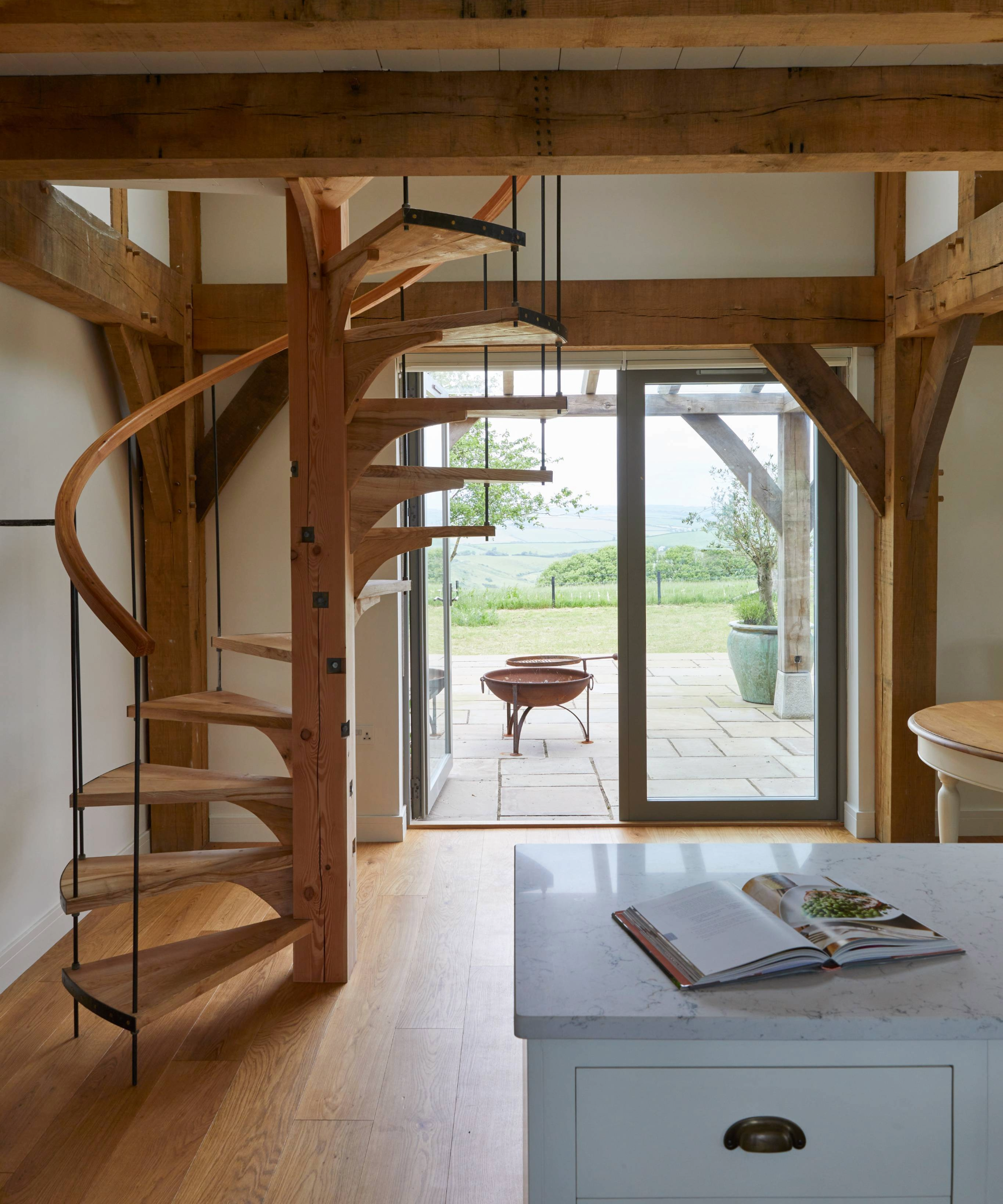
In order to integrate the new home into the landscape in the most natural way possible, the couple decided on a sympathetic oak framed structure, with natural isolation materials and recycled Devon slate tiles for the roof, which were salvaged from another farm building.
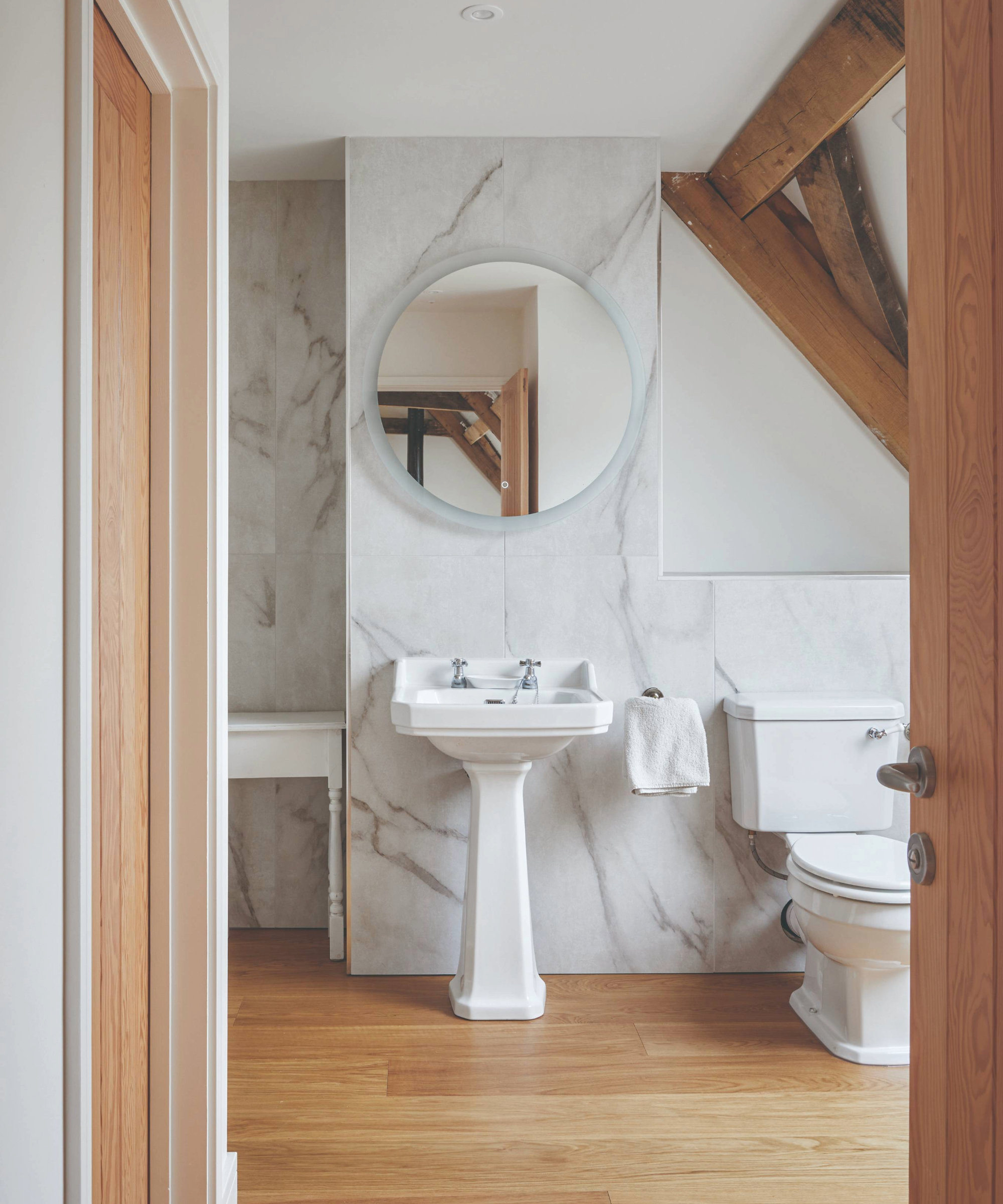
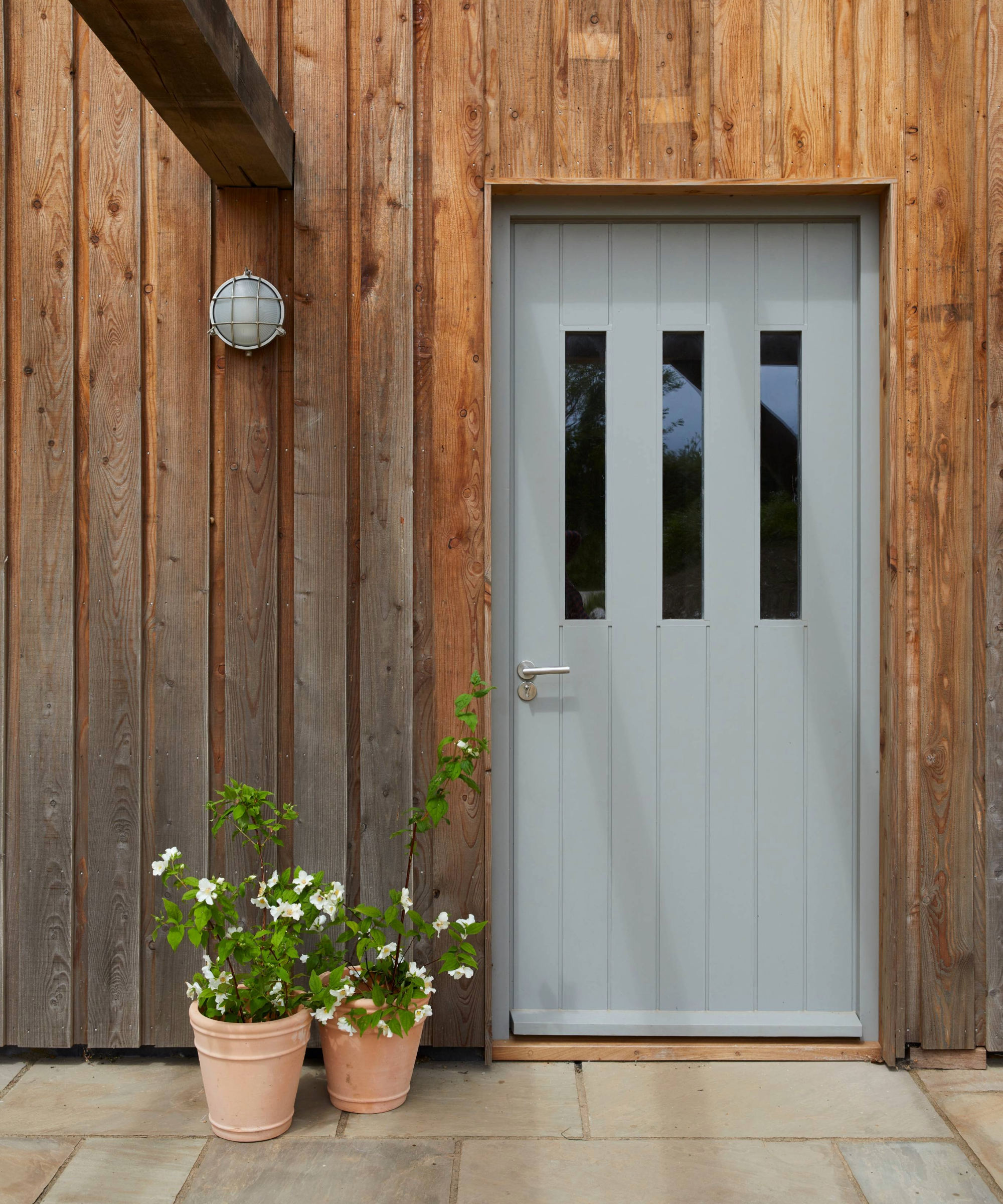
“We were very fortunate to use wood that is local to Devon, as well as benefiting from the skilled craftsmen that are available locally,” notes Susie. “All the timber for the cladding, flooring, doors and staircase was sourced locally from sustainable hardwood wood lots, milled by a local specialist timber merchant and worked on site by local and resident carpenters.”
“The entire process has been carried out by craftsmen, who are also valued friends, all of whom live within the community. Our local builder and celebrated artisan Adrian ‘Mad Dog’ Wotton, and a team of local craftsmen, constructed the house. They also built the Artisan Centre, with the farm café and farm shop, which has been embraced by locals and visitors to the area, making it a vibrant community hub.”
Eco credentials
Planning regulations required the dwelling to be carbon neutral, which was already a given for the couple. “In fact, we were aiming for as close to carbon negative as possible, and we’ve gone as far as we can to achieve this,” says Susie.
Using local timber minimised transportation emissions and they also reused and repurposed materials found on site wherever possible.
For self-sustaining elements, they installed an air source heat pump, a borehole and filtration plant for their own water, and a sophisticated sewage system
Image 1 of 1

Functional features
“Light and space were key in the interiors, particularly as it’s not a big space, while also providing comfort and quality,” says Susie. “My favourite part of the house is that it’s made from local materials and sustainable hardwoods. Working with local people who we know and who are dear to us meant that we were one big family and it was a lovely atmosphere while it was being built.”
Due to the fairly modest size of the home, the use of a covered outdoor space has complemented and expanded the overall living area.
“We put in a second request to the planners to add a veranda onto the outside of the front and rear of the house, which luckily they agreed to,” says Susie. “Our friends encouraged us as they knew, from our days living in Africa, about the importance of enjoying a ‘sundowner’ on the veranda before the day’s end.”
Image 1 of 2


How to achieve airtightness in an oak frame self-build
Ben Hancock-Parr, in-house architect at Carpenter Oak, says, “Traditionally, oak-frame houses are made from unseasoned ‘green oak’. The oak beams will shrink slightly after construction, causing a small amount of movement in the frame.
“This is not a structural issue; the frame becomes stronger over time. But it’s important to ensure even small movement does not affect building airtightness with these two principles:
1. Wrapping the oak frame
“Traditionally brickwork, or ‘wattle and daub’, would simply be placed between the beams of the oak frame to form the external walls. Inevitably in buildings constructed in this way there is air leakage between the oak frame and the infill materials.
“Instead, the walls and roofs of our buildings wrap around the outside of the oak frame, so that the oak frame is kept warm and dry within an airtight building envelope. So we refer to the walls and roof as ‘the wrap’. In which the oak frame can move slightly without affecting it.
2. Membrane airtightness
“In modern timber buildings, an airtightness membrane is formed inside the walls and roof. It’s important to ensure the continuity of this membrane.
“In our houses, the membrane sits between the oak frame and ‘the wrap’ and it’s important to factor this in when programming in the various trades on site.”
Image 1 of 1
A triumphant finish
Acting as project manager herself, Susie lived on site in a shepherd’s hut for a large part of the build process so that she could be close by to oversee everything. “My husband was working abroad, but my daughter came back and forth to join me for weekends, which was fun,” Susie recalls.
“Overall, we were lucky that the process went smoothly and positively – very much as a result of the wonderful team involved. I would impress on everyone the benefits of using people you already have a relationship with where possible. It makes the process so much more flexible and enjoyable. My husband and I now live here most of our time, which allows us to conduct our duties on the farm,” says Susie.
The couple are now nearing the end of the aforementioned three-year process and the farm is operating in profit – giving Susie and Robert the option to make it their full-time permanent dwelling.
The couple also plan to use this additional time spent on site to grow their business and organise guided walks of their farm to teach people the value of traditional farming systems.
Susie concludes, “We’re very proud of our soils that are rich in microbiology and organic matter,” says Susie. “We want to show others the wildlife and environmental benefits of organic farming.”
This stunning property won the Best Green Home category in Homebuilding & Renovating’s Awards 2024, in partnership with The Times and The Sunday Times. For more inspiration, take a look around this homely oak-frame self-build in Monmouth, with its fantastic views of the countryside.
View the original article and our Inspiration here
Leave a Reply