
The installation of new flooring represents a significant investment in any residential or commercial property. While aesthetic choices, such as wood species, plank width, and finish sheen, receive considerable attention, the critical component hidden beneath the surface—the adhesive—often gets overlooked. This oversight can lead to catastrophic and expensive failures.
The integrity, durability, and longevity of a floor are fundamentally dependent on the adhesive’s ability to protect. In environments where subfloor moisture is a concern, which is most environments, selecting an adhesive that incorporates a moisture barrier is an essential safeguard for the entire installation.
Here’s why choosing a flooring adhesive with moisture barrier matters:
The Destructive Science of Subfloor Moisture
To understand the necessity of a moisture barrier, one must first comprehend the pervasive nature of subfloor moisture. All concrete subfloors contain residual moisture from their pouring and curing process, and they continue to absorb ambient humidity from their environment. This moisture can naturally migrate from areas of high concentration to low concentration, a process known as vapor drive.
In a building, this typically means moisture vapor moves upward from the damp earth through the concrete slab and into the living space. Even wood subfloors in basements or over crawl spaces are susceptible to fluctuations in humidity. When this vapor encounters an impermeable flooring layer, such as a hardwood plank or luxury vinyl tile, it becomes trapped. For organic materials like wood, the result is absorption, which leads to dimensional changes: planks swell, cup, crown, or buckle.
For all flooring types, persistent moisture can break down the chemical structure of standard adhesives, causing them to emulsify and lose their grip—a condition known as adhesive failure. This results in tiles loosening, planks shifting, and hollow spots developing. Therefore, investing in a high-performance flooring adhesive with moisture barrier is essential because it can create a powerful, lasting bond between the flooring material and the subfloor.
Beyond Basic Bonding: The Integrated Solution
Traditional flooring installation often approaches adhesion and moisture control as separate, sequential steps. A common method involves rolling or troweling a liquid moisture barrier onto the subfloor, waiting for it to cure fully, which can take 24-72 hours, and then applying a separate adhesive to install the flooring. This two-step process is time-consuming, labor-intensive, and introduces potential points of failure, such as pinholes in the barrier membrane or incomplete coverage.
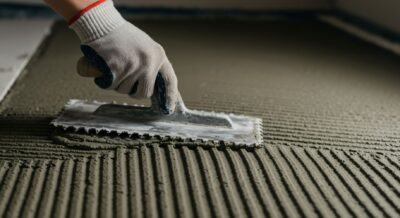
Modern integrated adhesives revolutionize this process. Engineered with advanced polymers like silane or polyurethane, these adhesives are designed to perform both functions simultaneously. When troweled onto the subfloor, they form a network of ridges. As the flooring is installed, these ridges compress to create a 100% adhesive transfer and bond. Critically, the chemical formulation of these ridges can also cure to form a continuous, flexible, and impermeable membrane that blocks moisture vapor transmission.
Evaluating Performance and Making the Right Selection
Not all moisture-protective adhesives offer the same level of performance. Key specifications must be evaluated to match the product to the project’s specific conditions. The most critical metric is the adhesive maximum allowable Moisture Vapor Emission Rate (MVER), measured in pounds per 1,000 square feet per 24 hours. A robust product will protect against levels of 12 lbs or higher, with premium formulations safeguarding against up to 18 lbs. Subfloor testing using ASTM F2170 is a non-negotiable prerequisite to determine the necessary level of protection.
Product selection also depends on the flooring material and job conditions. Thixotropic, or thicker, adhesives offer superior “initial grab” or hold-down strength, which is crucial for installing long, heavy planks or working on vertical surfaces like stair risers. More fluid, pourable adhesives enable faster coverage of large areas. Lastly, for interior spaces where air quality is a priority, such as homes, schools, and healthcare facilities, selecting a product with specific certifications ensures it meets stringent limits for volatile organic compound (VOC) emissions.
Tangible Benefits: From the Job Site to Long-Term Value
The advantages of using an integrated adhesive system extend far beyond technical performance. For flooring contractors, it can translate into tangible job-site benefits. It can streamline material procurement, reduce labor time and costs by eliminating an entire step from the process, and minimize callbacks due to moisture-related failures. This efficiency can enhance profitability and bolster a contractor’s reputation for quality and reliability.
For the property owner, the value is seen in long-term protection and peace of mind. The incremental material cost of a premium adhesive with a moisture barrier is minor compared to the total project cost, yet it insures the entire investment. The alternative, such as facing a floor failure that requires complete removal, potential subfloor remediation, and reinstallation, is financially and logistically burdensome. By proactively addressing the moisture threat, the flooring system’s lifespan is maximized, preserving its aesthetic appeal, structural integrity, and the property’s overall value.
Conclusion
Choosing a flooring adhesive is a foundational decision with long-lasting consequences. In the battle against the pervasive threat of subfloor moisture, a standard adhesive offers no defense, leaving a costly flooring investment vulnerable to a silent, destructive force. An adhesive with an integrated moisture barrier redefines the role of this unseen layer, transforming it from a simple bonding agent into an active, intelligent protection system.
By keeping the information mentioned above in mind, one can invest in a high-performance adhesive with a moisture barrier, which is a definitive standard for a successful, lasting installation.
View the original article and our Inspiration here
Leave a Reply