
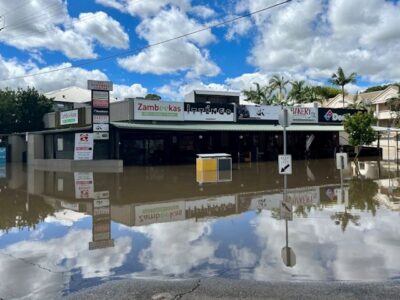
Nobody gives a second thought to water beyond its everyday use until it shows up where it doesn’t belong. A sudden dark patch spreading across your office basement floor, for example, is almost impossible to ignore.
Or imagine locking your doors on Friday, having a well-deserved weekend, only to walk into a literal swamp on Monday morning.
Water damage in commercial properties is a lot more than wet floors and soggy carpets. It’s lost work hours, disappointed clients or customers, safety issues for your staff, and most likely a nasty fight with insurance adjusters. If you’re really unlucky, it can threaten the future of your business.
This isn’t an exaggeration. According to a 2025 report compiled by the U.S. Congress, 40% of businesses never reopen after a major disaster like a flood. That’s why, even though most of us don’t think much about water day to day, having a clear plan for water damage recovery should be a core part of your business continuity strategy.
Common Causes of Water Damage in Commercial Properties
You might be thinking, “But it’s not yet the wet season, why are we talking about water damage?” The truth is that water damage to commercial property is not caused by rain alone. It’s usually the mundane things we don’t pay attention to.
Here are some common culprits:
Failed Plumbing: When was the last time you sat down to think about the plumbing in your building? Probably never. But plumbing failures in commercial properties are actually more common than you think, thanks to the sheer scale of piping involved.
According to the EPA, 10% of homes have leaks that waste up to 90 gallons of water every day. While this figure applies to residential buildings, scale it up to a commercial space with multiple restrooms, kitchens, or equipment lines, and you get an idea of what this looks like for businesses. With that much water flooding your office, you’re likely shutting your doors until the problem is fixed.
Leaky Roof: This is another common cause of water damage to buildings. The roof is meant to be your first line of defense against the elements, but if it has cracks, is missing tiles, or the drains are clogged, water will get inside during a heavy downpour. The result? Damaged ceilings, wiring, and insulation.
Backed-Up Sewage: This one is ugly. Backed-up sewage doesn’t just cause water damage; it also poses a health hazard to anyone in that environment. You’re dealing with contaminated water that can make staff and customers sick.
There are many reasons why this happens, including municipal sewer system failures, sump pump malfunctions, and drainage systems getting overwhelmed during heavy rainfall.
Flooding: We can’t talk about the causes of water damage without mentioning flooding. In fact, 2025 saw some parts of the U.S experiencing quite a number of floods, including in Texas, North Carolina, and New York City. If your property is in a low-lying area, a sudden afternoon flood can turn your parking lot into a lake.
What to Do After Commercial Water Damage
If you walk in on a Monday morning and see water where it shouldn’t be, what should you do?
Prioritize Safety
The first step is always safety. Turn off the electricity if it’s safe to reach the breaker. Unless the leakage is flood-related, shut off the main water valve immediately.
Document Everything
Next, do a comprehensive sweep of your premises to determine the extent of the damage. This documentation will include photos and videos before any water is removed. The goal here is to have some form of physical evidence in case you have to battle things out with your insurer.
Call the Professionals
Once that’s done, you can start thinking of getting the water out. Unfortunately, trying to mop it up yourself with a few shop-vacs usually doesn’t cut it for a commercial space.
This is where you get on the phone and contact a commercial water damage restoration service. These are experts whose job is to handle the water damage to your facility and get you back at work quickly and seamlessly.
They don’t just clear out the water you can see at the surface. Services like these, according to Remediation Specialists, use professional-grade vacuums, dehumidifiers, air circulation systems, and UV-equipped fans to fast-track the drying process.
The goal is to minimize secondary damage as much as possible, especially mold formation. And if any part of the place is damaged and requires fixing, they’ll handle that, too.
The best part? They’ll help you come up with a strategy to avoid similar problems in the future.
How to Prevent Commercial Water Damage
If you’ve ever experienced water damage to your property, you know how devastating it can be. How can you prevent it from happening again?
Know The Early Warning Signs
It starts with knowing what to look for. Usually, water leakage or damage will show up as colored stains on ceilings or walls, musty odors, mold, peeling paint, and warped flooring.
If you suspect water leakage but don’t see any of those signs, you may want to check your water bill. Leaks are the leading cause of high water bills for both residences and commercial properties.
Schedule Routine Maintenance
This is another key step you can take to prevent future water damage in your place of business.
It’s simple, really. Just create a maintenance schedule for your entire property or facility. This schedule should include frequent roof inspections, annual plumbing system checks, regular HVAC maintenance, and so on.
It might seem like a lot more extra work at first, but such routine maintenance can pay for itself in potential savings.
Take your roof, for example. The cost of home roof replacement is between $5,870 and $13,223, according to Angi. This figure is definitely a lot more for commercial properties. But when you carry out periodic maintenance of your roof, not only will it last you longer, you can easily catch minor issues before they become big and expensive.
Invest in Modern Leak Detection Systems
Finally, consider technology. Modern leak detection systems have gotten smart and more affordable.
These are sensors that send an alert to your phone the moment they detect moisture where it shouldn’t be. For a few hundred dollars, you could get a warning at 2 AM on a Sunday and potentially save hundreds of thousands.
Protect Your Commercial Property in 2026
Running a business in 2026 is difficult enough without swimming in problems, which is what would happen if you ever experience water damage in your workplace. Hopefully, this article has shown you what to do to protect your place of business.
The key is not to wait until something happens before making a move. Start preparing today, even if it means creating that maintenance schedule you’ve always been putting off.
View the original article and our Inspiration here
Leave a Reply