
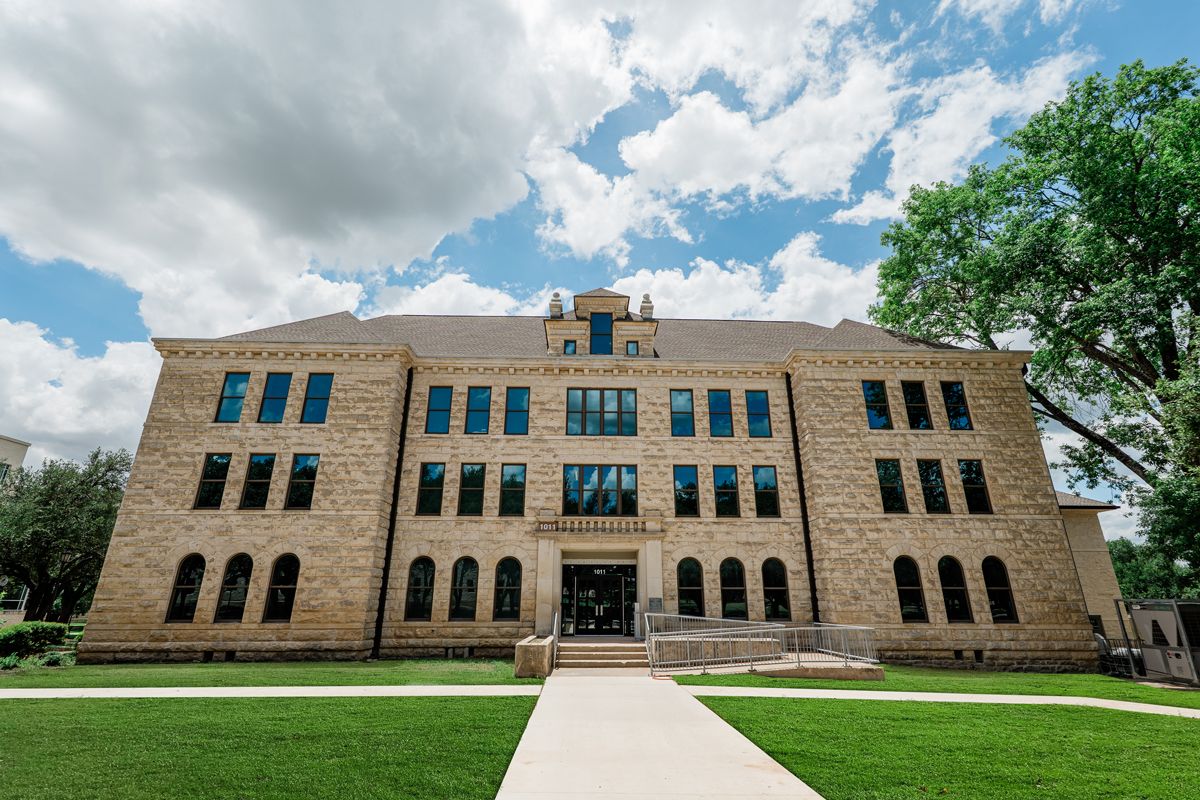
For 186 years, Southwestern University has been equipping students to become the leaders of tomorrow while simultaneously recognizing the institution’s rich history as the first university in Texas. Southwestern’s tradition of looking to the future while honoring the past is on full display this fall as the University celebrates the grand re-opening of one of its most historic structures.
Mood-Bridwell Hall, originally opened in 1908 and added to the National Register of Historic Places in 1975, has undergone a $25 million renovation that restored the prestige of the historic structure while incorporating the latest classroom technology.
“Mood-Bridwell Hall is a very historic building on campus,” says Southwestern University Associate VP for Facilities Management Amanda Barber. “It is one of the anchor buildings that define the characteristic look of the campus from an exterior facade perspective. It is historically relevant in that sense, but it’s also currently relevant because it is preserving the soul of the campus look.”
Together with project management firm Kitchell, general contractor Linbeck, and architect PBK, Southwestern University leaders reimagined the historic structure to become a hub of 21st Century learning. Renovating the nearly 40,000 square foot building required close coordination between all partners to preserve the historic features of the 117-year-old structure.
The renovation would not have been possible without collaboration between Southwestern and the City of Georgetown, the University’s home located about 30 miles north of the Texas capitol of Austin. Leaders from the University and its construction partners worked alongside Georgetown’s Historic and Architectural Review Commission (HARC) to ensure compliance with local guidelines.
“The City of Georgetown planning and permitting teams have been outstanding partners,” Barber says. “Without their involvement and their knowledge of code compliance and permitting, we would not have been able to achieve this renovation. They have been really good to work with, and you don’t see that kind of partnership and collaboration in many jurisdictions.”
Mood-Bridwell Hall was originally constructed in the Richardson Romanesque style using limestone blocks quarried at the nearby Brushy Creek Quarry in Round Rock, Texas. The original stonework was completed by Waterston and Sons stone cutters, the same masons who immigrated to the United States in the 1880s to work on the construction of the Texas State Capitol Building. During the renovation, crews worked meticulously to preserve the century-old facade of the building.
“The building is over 100 years old, so not only does it have historical value for the University, but for the City of Georgetown as well,” says Kitchell Project Manager Josiah Cortez. “It is listed in the City’s historical archives as a building of importance, so there were a lot of design elements that we were not allowed to touch. It took a lot of teamwork from every group to get it to where it is now. It took quite the effort but this is one project that many people can be proud of.”
Comprehensive stonework was completed, including the repointing of joints and thorough cleaning of the limestone blocks. A variety of repairs were completed to correct defects that had arisen throughout the building’s history. A new roof as well as new, energy-efficient windows were also installed, allowing the exterior to shine bright.
A State-of-the-Art Appeal
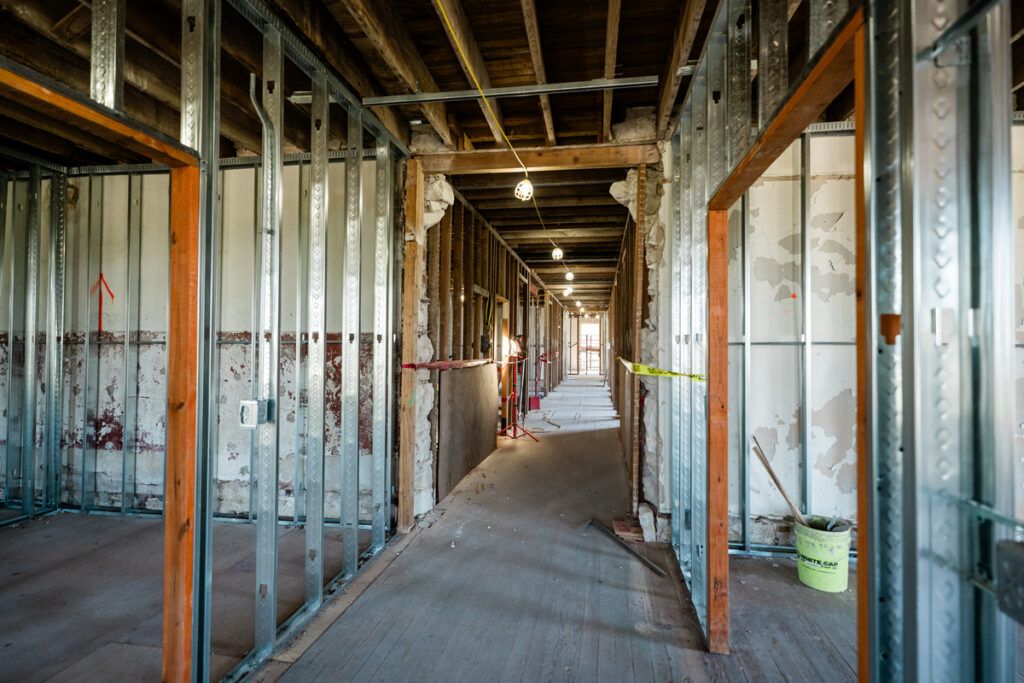
Inside Mood-Bridwell Hall, the interior was scaled back to its original studs and foundations. From there, the building was reimagined. State-of-the-art classrooms, faculty offices, meeting spaces and even a coffee shop, were woven among the original beams, pillars and columns that date back to the early 20th Century, resulting in a unique blend of old and new.
“It’s not completely uncommon to take on a project like this, but there are very few of them that are this old,” Cortez says. “We were working with the existing foundations that were constructed in 1908, so there were a lot of unknowns that we had to take into consideration. It’s not unheard of, but there are just very few projects of this magnitude on such an old building.”
When originally constructed, Mood-Bridwell Hall featured a large, open-air atrium in the center of the building. Today, one of the building’s new defining characteristics is a large skylight that fills the atrium with natural sunlight in a nod to the building’s original construction. Unused roof space on the second floor was transformed into a new outdoor terrace designed to become an outdoor classroom and central gathering place.
On the north side of the building, a two-story annex was constructed, adding about 1,500 square feet of space and allowing for the addition of several new classrooms. Renovated classrooms feature advanced projection systems alongside enhanced wifi and networking capabilities.
The main atrium is home to an interactive video wall, and state-of-the-art, environmentally-friendly Epson printing systems were installed on each floor. These systems use 50% less power and utilize a water-based ink system, eliminating the need for petroleum-based toner.
 The Next Generation
While envisioning the renovation of Mood-Bridwell Hall, University leadership wanted to ensure that its next century of use will be as impactful as its first. When it opened in 1908 as a men’s residence hall, the building held 80 bedrooms and was the first building on campus with steam heat, electricity and bathrooms on every floor.
During World War I, Mood-Bridwell Hall was transformed into barracks for the Student Army Training Corps. Just a few years later, in 1925, it served as a women’s dormitory after the Ladies Annex burned down. When the V-12 Navy College Training Program came to Southwestern during World War II, Mood-Bridwell Hall again became a women’s dormitory while Laura Kuykendahl Hall, the women’s residence hall, was utilized by Naval trainees.
Throughout history, it also served as a campus dining hall, library, and infirmary. In 1965, the building was converted to house faculty offices, campus organizations and classrooms. Today, Mood-Bridwell Hall is ready to serve the next generation of students, faculty, and staff with new classrooms, office space, and other amenities designed to build community.
Barber says the project sends the right message to the faculty, staff and students that Southwestern is committed to preserving its soul, history and traditions. “It is a really rich story that is Southwestern, while providing clean, functional, desirable and modernized spaces that are conducive to learning and achieving the mission of the University.”
Andrew Felts is Director of Communications and Public Relations at Southwestern University. For more information, visit southwestern.edu.
View the original article and our Inspiration here
Leave a Reply