
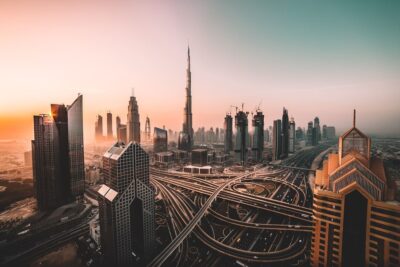
If you’re into real estate, one of the hottest places that should be at the top of your list is the Middle East. For too long, it has been a region that has been overlooked due to regional tension and conflicts. However, in recent years, as stability has increased, several countries have shown promise as prime investments for real estate.
Look at the United Arab Emirates, for example. According to Statista, its real estate market was projected to reach close to $700 billion this year. Inside this market, the residential segment itself is set to be worth nearly $402 billion as well.
Given the opportunity that presents itself, what should you know before investing in the region? That’s precisely what we’ll explore today. Let’s jump right in.
#1. Real Estate Growth is Happening in Conjunction With Demographic Changes
Until the early 2000s, thriving cities like Dubai were closed off and restrictive to foreigners. However, in 2002, the Freehold Law was introduced, which allowed foreigners to buy, sell, and rent property. Since then, Dubai real estate investors have seen their portfolios grow exponentially.
According to RD Dubai, favorable tax workings of the city are largely responsible for this. Of course, with this growth also come tourists and immigrants, and Business Insider sat down with three portfolio managers in the city to understand things better.
Mark Oshida, a regional head of Cambridge Associates, believes that the city has been very open and tolerant to people from all types of countries. However, this has also had some other consequences, such as home prices rising by 70% since 2019. Several other portfolio managers enjoyed living in Dubai, but eventually wished to return home.
Thus, if you’re banking on long-term contacts with your investments, these are implications worth considering.
#2. Tourism Makes Real Estate A Critical Requirement
One of the biggest factors that is impacting real estate in the Middle East is tourism. In Saudi Arabia, tourists were responsible for spending almost $50 billion in Q1 of 2025 alone. Likewise, according to data from the Dubai government, the city saw close to 14 million international visitors between January and September this year. Unsurprisingly, this led to a staggering 32.70 million nights booked in a range of accommodations.
In other words, real estate for short-term stays is one of the most lucrative angles to target. Areas like Palm Jumeirah, Emirates Hills, and Downtown Dubai are home to some of the most luxurious properties. Real estate prices are going to be the highest here, but you also have the benefit of tapping into the rich tourist crowd.
At the same time, if you’re hoping to target family housing and mid-range properties with long-term contracts, localities like Arabian Ranches, Jumeirah Village Circle, and International City would be ideal. Both options, luxurious and affordable, give you access to plenty of customers, but they tend to have some unique requirements.
For instance, customers in more luxurious regions tend to expect the best of the best when it comes to amenities and furnishings. Anyone in real estate knows that this increases budgets considerably before even factoring in the maintenance costs it brings. Thus, consider as many factors as you can and speak to experts in the region before making any decisions.
#3. Ownership Concentration and Governance Are Still Factors to Consider
While real estate is a great investment today in several Middle Eastern countries, there are still a few factors that make things a little complicated. Ownership concentration is one such example. Despite more investment and ownership by international investors, the majority of real estate is still controlled by a tiny group of high-net-worth people.
This becomes another factor to think about in terms of market behavior. In case of slowdowns in real estate, aspects like price adjustments will be consciously influenced by the decisions of the tiny group of mega-investors. This might impact how much you can sell or rent for in a way that’s out of your control.
Likewise, many real estate firms are pushing for fractional ownership models in the Middle East today. It’s a great idea in theory, and while the region has become more relaxed with things like escrow rules and the registration process, it’s still in a nascent stage. So, if you have a high-risk appetite and are willing to verify exit options and clear ownership legalities, go for it. Otherwise, maybe exercise some caution.
Long story short, the Middle East, particularly the U.A.E. and Saudi Arabia, is becoming increasingly popular among real estate investors. With the Crown Prince, Mohammed bin Salman, recently meeting President Donald Trump and the air of new positive relationships, this is a great time to consider investing.
View the original article and our Inspiration here
Leave a Reply