
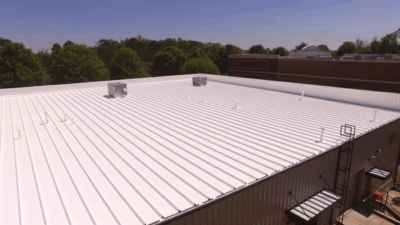
A deteriorating 50,000-square-foot metal roof forces a six-figure decision that most CFOs get wrong. The math seems simple: replacement costs $300,000 to $500,000, restoration costs $75,000 to $150,000.
But the real story emerges over 10 years, when the total cost of ownership, energy savings, and capital preservation are factored in. While facility managers focus on leaks, financial leaders must evaluate cash flow impact, asset lifecycle extension, and ROI. The question isn’t whether restoration works, it’s whether replacement actually makes economic sense.
When Metal Roofs Reach the Critical Decision Point
Metal roofing systems are known for durability, but they are not immune to aging. The critical decision point typically occurs 20–30 years into a roof’s life, when visible issues begin to surface, and repair costs become more frequent.
Common Conditions That Trigger Evaluation
Rust, fastener failure, seam separation, and panel movement are the most common warning signs. While these issues may initially appear localized, they often indicate broader system fatigue. Left unaddressed, minor defects allow moisture intrusion, accelerate corrosion, and compromise insulation and decking.
Why Timing Matters Financially
From a financial perspective, early intervention preserves options. Once corrosion becomes structural or moisture saturation spreads beneath panels, restoration may no longer be viable. CFOs benefit most when roofs are evaluated before deterioration crosses that threshold, allowing restoration to remain a cost-effective alternative to replacement.
What Metal Roof Restoration Actually Involves
Metal roof restoration is often misunderstood. It is not a temporary patch or cosmetic coating. When executed correctly, it is a comprehensive system designed to stabilize, seal, and protect an existing roof for decades.
The Restoration Process Explained
The process begins with thorough surface preparation, including power washing and rust treatment. Failed fasteners are secured or replaced, seams are reinforced with fabric and base coatings, and all penetrations are sealed.
Finally, a high-performance elastomeric or silicone coating is applied across the roof surface, creating a seamless, reflective membrane.
What Restoration Is Not
Restoration is not a shortcut, nor is it appropriate for every roof. Low-quality coatings applied without proper preparation often give restoration an unfair reputation. Proper systems are engineered solutions, backed by manufacturer warranties and designed to perform as long-term assets.
The 10-Year Cost Comparison: Restoration vs. Replacement
For CFOs, the decision ultimately comes down to total cost of ownership. When viewed over a 10-year horizon, the cost differential between restoration and replacement becomes difficult to ignore.
Upfront Capital Expenditure
A typical metal roof restoration for a 50,000-square-foot facility costs between $75,000 and $150,000. A complete replacement typically falls between $300,000 and $500,000, depending on tear-off requirements, insulation upgrades, and structural modifications.
Ongoing Maintenance and Repair Costs
Replacement systems often come with higher upfront warranties, but they still require preventative maintenance to remain compliant. Restoration systems, when paired with preventative maintenance plans, offer predictable, lower annual costs and reduce the likelihood of disruptive emergency repairs.
Energy Efficiency and Operating Savings
Reflective restoration coatings significantly reduce heat absorption. Many facilities experience measurable HVAC savings, particularly in manufacturing and warehousing environments with large roof footprints. Over a decade, these energy reductions compound, further improving ROI.
Tax and Depreciation Considerations
In many cases, restoration qualifies as a capital improvement rather than a repair expense, allowing accelerated depreciation. While tax treatment varies, restoration often aligns well with CFO strategies focused on capital efficiency and balance-sheet optimization.
Lifespan Extension and Asset Preservation
One of the most compelling financial arguments for metal roof restoration is the extended lifespan it provides. Properly restored metal roofs routinely gain an additional 15 to 20 years of service life.
Unlike replacement, which resets the lifecycle clock at a high cost, restoration can be repeated. Multiple restoration cycles over several decades often cost less than a single replacement while keeping the building continuously protected and operational.
Sustainability and ESG Considerations
Sustainability is no longer a secondary concern; it is a boardroom issue. Metal roof restoration aligns well with ESG initiatives by reducing landfill waste, minimizing raw material consumption, and lowering a building’s carbon footprint.
Avoiding tear-off keeps thousands of pounds of roofing material out of landfills. Reflective systems also reduce energy demand, supporting corporate sustainability goals while delivering tangible operating savings.
When Restoration Is Not the Right Solution
Metal roof restoration delivers substantial financial and operational advantages, but only when the underlying structure can support it. Knowing when restoration should not be pursued is critical to avoiding wasted capital and compounding risk.
In certain conditions, replacement isn’t just the safer choice; it’s the only responsible one. The key is identifying these red flags early through a transparent, professional evaluation.
Restoration is typically not viable when:
- Structural decking is compromised, showing signs of rot, deflection, or load failure
- Corrosion has progressed beyond surface oxidation, weakening panels or fasteners at a structural level
- Widespread moisture intrusion has saturated insulation or decking beneath the metal panels
- Design limitations or roof geometry prevent proper adhesion of restoration systems
- Previous low-quality coatings or repairs have created compatibility issues with modern systems
Choosing the Right Restoration Partner
The success of a restoration project depends heavily on who executes it. From a CFO’s standpoint, contractor selection is a risk-management decision.
Qualified restoration partners provide detailed inspections, moisture testing, and documentation. They use manufacturer-backed systems, offer non-prorated warranties, and clearly outline maintenance requirements. Most importantly, they understand how roofing decisions impact operations, insurance exposure, and capital planning.
For organizations evaluating metal roof restoration as a capital strategy, working with Duratec Roofing Solutions in the Greater Atlanta area ensures that restoration systems are designed to address corrosion, energy efficiency, and long-term asset performance, not just immediate leaks.
Real-World Results in Industrial Facilities
Across manufacturing and warehousing sectors, restoration has proven its value. Facilities often report avoided shutdowns, reduced interior disruption, and improved temperature control after restoration. In some cases, cooler interior conditions even contribute to productivity gains, reinforcing the operational upside beyond simple cost savings.
The Strategic CFO Takeaway
Roofing decisions are no longer just facilities issues; they are financial strategy decisions. Over a 10-year horizon, metal roof restoration frequently outperforms replacement by preserving capital, reducing operating expenses, and extending asset life without operational disruption.
The most expensive roofing decision is often the one made too late. By evaluating restoration early, CFOs retain flexibility, control costs, and align building assets with broader financial and sustainability objectives.
Feature image courtesy of Duratec Roofing
View the original article and our Inspiration here
Leave a Reply