
Major European cities such as Dublin, Amsterdam, and Barcelona have been facing rising overcrowding and worsening real estate shortages in the last few years. Soaring property and rent prices, complicated urban planning and zoning requirements have all exacerbated this issue. Companies dealing with rapidly increasing expenses have also faced a concerning lack of affordable office and coworking spaces.
Cities like Vilnius are now exploring alternative real estate solutions such as converting underused older buildings and structures, instead of building new ones.
“We’re seeing a clear shift in favour of conversion projects over new developments. With construction costs, timelines, and financing rates all higher than in previous years, conversions often present a more efficient and lower-risk model,” Gustas Germanavicius, founder and CEO of real estate crowdfunding company InRento, highlighted.
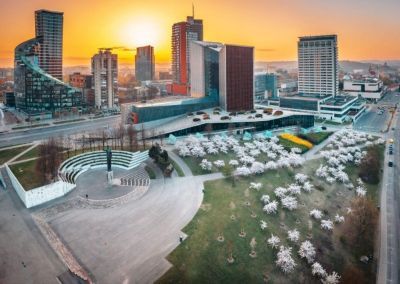
Image Courtesy of: Andrius Aleksandravicius
How building conversions can make better cities
Building conversions can be a great way of acquiring new communal, living and working spaces, while keeping costs and carbon emissions low in the long run and boosting investor returns. They can revive urban environments and communities, contributing to a city’s social and economic health, by providing diverse housing and communal options and creating a strong sense of communal ownership. Conversions also reduce urban sprawl, preserving more compact and efficient city designs. Modernising older structures can also make them more climate-resistant.
“By reusing existing structures, developers reduce build time and uncertainty while unlocking strong value through repositioning. Investors also appreciate the faster cash flows and clearer exit paths these projects provide compared to long-term speculative developments,” Germanavicius noted.
Studies have found that conversion projects cost about 20% to 30% less than erecting a similar-sized building. According to InRento data, returns from the company’s conversion projects average around 12.5% per annum, compared to 9% per annum for buy-to-let projects.
Vilnius quietly backing conversions
In the last few years, Vilnius’ Uptown has rebranded itself as a dynamic and modern neighbourhood, blending its previously industrialised Soviet past with forward-looking business, living and leisure projects. “The change in Uptown is obvious. Abandoned areas are turning into vibrant neighborhoods. What looked like an urban eyesore yesterday is becoming a desirable address today,” noted D. Zakaitis, founder of Tech Zity, a network of workspaces around Lithuania.
Zakaitis is now focusing on building the largest tech campus in the EU by converting the former Lelija sewing factory complex into a 55,000 square metre campus in Uptown. This move is expected to affirm Uptown as the startup and technology hub. “We aim for it to become one of the central hubs of Uptown: a vibrant, multifunctional, 24/7 urban living center. It will be a place where business, technology, events, health, education, gastronomy, and childcare will coexist,” Zakaitis said.
He added: “The space will feature not only offices but also co-working areas, a conference center, restaurants, green areas, and co-living spaces. This will help neighborhoods recover, gain a new identity, and build self-confidence.” Vilnius has already converted an old sock factory into its Uptown tech campus, Cyber City, which is now fully occupied by Lithuanian startups including Hostinger, Nord Security and Surfshark. However, it still has hundreds of underused buildings.
“The demand for non-standard, distinctive spaces is huge, because businesses today are looking not only for square meters, but also for a meaningful context. This transformation will only intensify over the next 5-10 years.”
Challenges and long-term potential
Although building conversions provide clear value, they can pose challenges such as obtaining permits, complicated heritage protection rules, hidden structural problems and infrastructure adaptation timelines.
“The biggest challenge is learning to see old buildings not as a problem, but as an opportunity. Vilnius has a large number of industrial structures that have served a single purpose for decades and now stand empty, simply because there’s no clear mechanism for bringing them back to life,” Zakaitis pointed out.
However, the European Commission is also now encouraging the reuse of spaces and buildings with initiatives such as “HouseEurope! Power to Renovation” and the Renovation Wave Strategy. This may make these projects even more relevant and profitable in the long run.
“Rising sustainability standards and regulatory changes are making the adaptive reuse of buildings increasingly attractive, both economically and environmentally,” Germanavicius said.
View the original article and our Inspiration here
Leave a Reply