
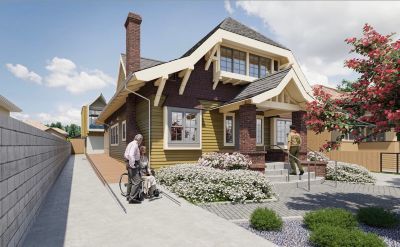
The architecture and preservation firm Page & Turnbull, has announced the groundbreaking of a transformation of the Young Korean Academy, a Craftsman-style residence and cultural touchstone for the Korean American community that dates to 1910, into a new multiuse cultural center. Led by Korea’s Ministry of Patriots and Veterans Affairs and the project leader Heritage Smart Consulting Group, a celebration and ceremony for this transformational rebuilding project will be held this Thursday, December 11 at 2:00pm.
A longtime community hub located in the Expo Park neighborhood of Los Angeles, the unassuming building and property served as the headquarters of the Young Korean Academy, also known as Hung Sa Dahn (흥사단), from 1929 until 1948. The South Catalina Street location, founded in 1913 by renowned Korean independence activist Dosan Ahn Chang Ho, later became the civic organization’s U.S. headquarters, serving as a hub for civic education, youth leadership, and independence activism for the Korean diaspora in America.
Slated to attend the groundbreaking is a large delegation of descendants connected to major heritage sites, as well as several Korean dignitaries and local leaders including Calif. State
Senator Dr. Steven Choi. Senior leaders and staff from Korea’s Ministry of Patriots and Veterans Affairs (MPVA), as well as Kim Young-wan, Consul General of the Republic of Korea
in Los Angeles, will also be in attendance. Additional invited guests include Los Angeles City Councilmember John Lee (14th District), who is of Korean ancestry; Ken Bernstein, manager of
the Los Angeles Office of Historic Resources; and Adrian Scott Fine, President and CEO of the Los Angeles Conservancy. Others participating in the groundbreaking include Korean National Association Memorial Foundation, Hung Sa Dahn U.S. Headquarters & Los Angeles Chapter, Southwest Chapter of the Korean Liberation Association (Gwangbokhoe), and student delegates from Hung Sa Dahn Boy Scouts 777 and the Hwarang Youth Foundation.
Several descendants connected to the Young Korean Academy and the historic Korean Aviation School (1920-1921), which was established in Willows, Calif, and later served as Inspiration for the establishment of the Republic of Korea Air Force, will join the celebration from their homes in San Diego.
“The Young Korean Academy site is one of the very few historic properties in the United States directly acquired by the Korean government, that symbolizes Korea’s enduring commitment to its diaspora and establishing a living bridge between Korea and the United States,” says Jong Hyun Lim, project leader and steward of the Young Korean Academy project and founder of Heritage Smart Consulting Group. “This work embodies the concept of ‘shared heritage,’ where Korea and the host country recognize and preserve common historical and cultural values, transcending national boundaries and advancing cultural diplomacy, setting a model for international heritage cooperation.”
Designated Los Angeles Historic-Cultural Monument No. 1274 in 2023, the complex at 3421 South Catalina Street occupies a unique historical position, according to architect John D. Lesak, AIA, LEED_AP, FAPT, principal at Page & Turnbull in Los Angeles. “This humble presence belies its significance as a powerful symbol of transnational activism and shared heritage between Korea and the United States,” says Lesak, an expert in historic Los Angeles. “Part museum and cultural center and part research archive, the Young Korean Academy is just one example of the Korean government’s global efforts to preserve historic sites connected to the independence movement, spanning 1,422 overseas historic and commemorative sites across 39 countries, including 1,032 independence-movement sites. In the United States alone, 159 such sites have been documented, with significant heritage landmarks including the Korean Legation in Washington, D.C. and the Willows Korean Aviation School in Glenn County, California.”
A National and Global Effort
Last year, in anticipation of the 80th anniversary of Korea’s liberation, leaders from the Korean government identified the Young Korean Academy in Los Angeles as one of 159 historic U.S.
sites to be adapted as part of the transformational, meaningful campaign to activate Korea’s heritage and foment wider public appreciation of the little-known history of Korean Americans.
According to the Los Angeles Conservancy, an influential preservation group, “The property is exemplary as a rare and enduring Korean American institutional property in Los Angeles,” and
“the location from which Hung Sa Dahn operated from 1929 to 1979, the site’s period of significance.” The group calls the buildings “intact and rare examples of early institutional properties associated with Korean American immigration, settlement, and development.”
The project’s exterior restoration supports and enhances the historic main building, according to Page & Turnbull. Throughout the property, the firm has directed the preservation of significant historic attributes, both on the building’s interior and exterior. New outdoor spaces will incorporate traditional Korean plants and a new seating area with a water feature and other gathering areas to unite the community. There is also a new interior space dedicated to personal reflection and educational exhibits, immersing visitors in the experience of Korean Americans.
With full site accessibility a key goal for the renewed complex, Page & Turnbull’s design incorporates a two-sided, ground-level elevator that will transport visitors to the second floor of the annex and main buildings. An existing garage is being converted into a catering kitchen with a storage room, and the YKA’s annex building has been reimagined with a first-floor multipurpose room and a second-floor office suite. The project also introduces a new decorative fence along its public sidewalk and, at the campus perimeter, a “Wall of Remembrance – Wall of Us” that lists significant dates in the history of founder Ahn Chang Ho and other important events.
About Page & Turnbull
Page & Turnbull is an architecture and planning firm that transforms the built environment through design, research and technology. Located in San Francisco, Los Angeles, Sacramento, and San Jose the firm comprises three Studios: Architecture + Design, Historic Architecture, and Cultural Resources Planning. Collectively, Page & Turnbull’s staff includes architects, designers, historians, planners, and
conservators with a mission to imagine change in historic and contemporary environments to cultivate thriving, sustainable, and resilient communities. More at www.page-turnbull.com.conservators with a mission to imagine change in historic and contemporary environments to cultivate thriving, sustainable, and resilient communities.
More at www.page-turnbull.com.
About MPVA
Honoring those who have sacrificed and dedicated themselves to the nation is one of the most fundamental responsibilities and duties of any country. Just as deeply rooted trees do not sway in the
wind, a nation that has a strong foundation in remembrance and respect for its heroes can overcome any challenge with wisdom and resilience. For this reason, veterans affairs—at the very heart of our
Republic—must be broad in scope and deeply rooted, and we must always listen attentively to the voices from the field. Guided by the principle of Maesajinseon (每事盡善)—doing our best in every endeavor—the Ministry of Patriots and Veterans Affairs is fully committed to developing and advancing policies that honor those who have served the nation. We will devote our utmost efforts to ensuring that the noble sacrifices made for our country are treated with dignity, and that Korea’s veterans affairs system reflects its rightful stature on the global stage. We are committed to building a veterans system that reflects the stature and responsibility of a nation that has come into its own— where extraordinary sacrifice is met with exceptional recognition, and service to the country is upheld as the highest honor.
The Architecture of the Young Korean Academy
Originally constructed as a single-family Craftsman-style wood-framed home, the 1910 multifamily residence features wood shingles and clapboard cladding. The jerkinhead roof, which combines hip roof and a gable roof attributes, incorporates flared eaves punctuated by cross-gabled dormers. Among the architectural elements that distinguish the residence and two porches are gabled roofing with decorative wood elements and arched openings. Some doors, windows and sidelights are characterized by carved wood corbels.
A 1932 interior remodel of the 1910 residence opened the wall between the living and dining rooms. Subsequent adjustments widened the front porch’s original stoop, converted the ground floor into three residential units, added stone cladding, and removed the chimney along with other renovations. In addition, a one-story detached garage with a gabled roof was constructed at the southwest corner of the lot in 1950 and in 1958 a wood-frame, two-story duplex was constructed in the Minimal Traditional architectural style at the rear of the lot.
Image Courtesy of: Page & Turnbull
View the original article and our Inspiration here
Leave a Reply