
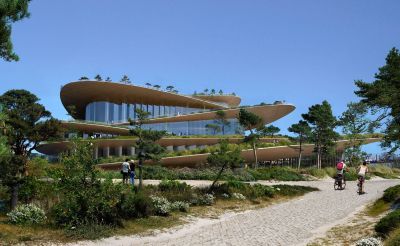
Selected by a unanimous jury, BIG – Bjarke Ingels Group will design the new home of the Hamburg State Opera. Located on the Baakenhöft peninsula in HafenCity, the project will house the State Opera and the Hamburg Ballet, providing state-of-the-art production and performance facilities for the city, while opening new public spaces along the waterfront.
Image Courtesy of: Yanis Amasri
Replacing the 1950s State Opera building on Dammtorstraße, the new 45,000-m2 venue responds to the city’s need for a modern house that meets contemporary acoustic, spatial, and technical standards. The new opera sits within Hamburg’s evolving waterfront – a city that has long intertwined culture and harbor life, from the Speicherstadt warehouses to the Elbphilharmonie – continuing the dialogue between civic architecture and the water’s edge.
“The new Hamburg State Opera inhabits an island at the heart of HafenCity bookended by the vertical landmarks of Elbturm and Elbphilharmonie.
The opera will appear like a landscape of concentric terraces – emanating like soundwaves from a central beating heart of music, expanding outward into the harbor like ripples on the surface of the sea. The result is a three-dimensional public park open and accessible from all sides, with expansive views in all directions – to the old city and the new, to Lohse Park and the industrial port.
We are honored to have been chosen to imagine this key puzzle piece in the transformation of Hamburg’s HafenCity, and we are deeply grateful to Herr und Frau Kühne to be entrusted to turn their generosity into the city’s new epicenter for the performing arts.” – Bjarke Ingels, Founder & Creative Director, BIG
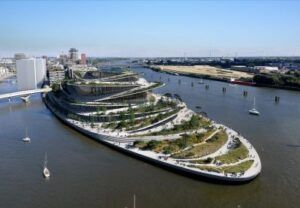
Image Courtesy of: Yanis Amasri
Conceived as a public building within a park, the opera house unfolds as a series of terraced landscapes rising from the water’s edge. Seen from above, the roof traces a continuous circular form that opens toward the harbor. This sculpted topography offers pathways across the building, moving from the quay to elevated gardens, creating outdoor gathering spaces and a new public link between the city and the river.
Whether arriving by foot, taxi, or bus, visitors can enter the opera from several directions – through the park, from the pier, or directly from the ‘opera street’ by Baakenhafenbrücke. Stone pavements from the park continue into the main foyer, which acts as an urban living room, where two central timber staircases lead visitors through the building. All main floors have direct access to outdoor terraces, which can transform into arrival points, event spaces, and gathering places for performers, guests, and visitors alike.
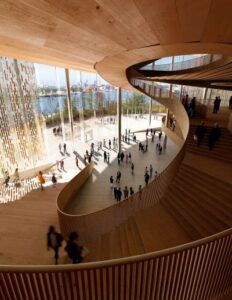
Image Courtesy of: Yanis Amasri
At the heart of the building, the main hall gathers the audience and performers within a room of gently curved balconies. Bands of horizontally layered timber wrap the interior, creating a continuous surface that carries sound evenly through the space.
“The main hall is the heart of the project – a space with state-of-the-art acoustics and perfect sightlines to the stage. Immersive concentric wooden rings shape the hall and its balconies, dissolve the boundaries between spectators and artists, between reality and fiction.” – Jakob Sand, Partner, BIG
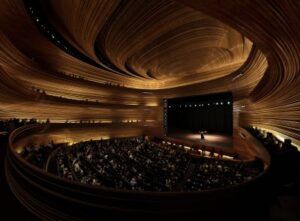
Image Courtesy of: Yanis Amasri
Behind the main hall, a smaller studio stage, rehearsal rooms, and back-of-house areas are arranged for direct connection to the stage, allowing artists to move fluidly between practice and performance and to ensure an efficient flow of activity throughout the building.
“The new state opera is an invitation to the public to experience their city, the harbor and the opera from a new perspective. Visitors can move along the facades and glimpse into the foyer, rehearsal rooms, backstage areas and offices, revealing the complexity behind a working opera house. With no back side and indoor levels connected to the three-dimensional landscape, the building is open toward its surroundings on all fronts.” – David Zahle, Partner, BIG
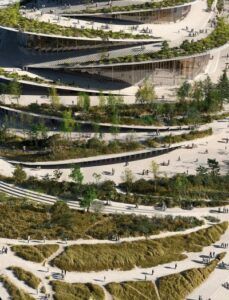
Image Courtesy of: Yanis Amasri
Shaped by the movement of the water, the surrounding park is designed by BIG Landscape and manages storm surges through sloping terraces, vegetated dunes, and wetland gardens that slow and absorb the flow. Basins collect and retain rainwater, creating habitats for amphibians, aquatic plants, and local species. The combination of tidal zones, resilient vegetation, and permeable surfaces supports biodiversity and forms a living landscape that adapts to the changing rhythms of the Elbe.
View the original article and our Inspiration here
Leave a Reply