
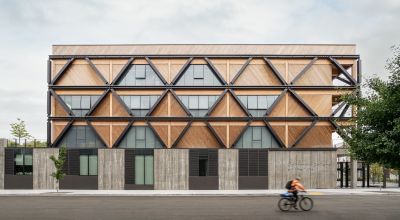
Studio Gang’s new building at the California College of the Arts (CCA) expands on the school’s San Francisco campus, establishing a vibrant indoor-outdoor environment for learning and making that strengthens relationships among varied people, ideas, and creative practices.
Founded during the Arts and Crafts movement at the turn of the 20th century, CCA has grown to encompass 34 art and design disciplines, from jewelry, ceramics, and textiles to metal arts, architecture, and animation. Conceived as a creative ecosystem where different disciplines can productively interact and overlap, the building physically extends from CCA’s existing main academic building, providing new art-making facilities, learning spaces, and green spaces that support its diverse community.
The 82,300 square-foot building’s concrete ground level is a hub of indoor-outdoor workshops for more physically intensive art-making practices and fabrication. Organized around shared materials and equipment, this level’s open, flexible plan makes the different programs easily visible and accessible to one another, promoting interdisciplinary interaction and providing adaptability as new needs, mediums, and technologies develop.
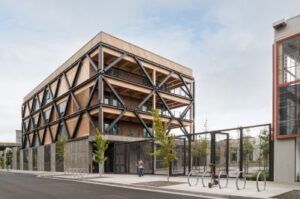
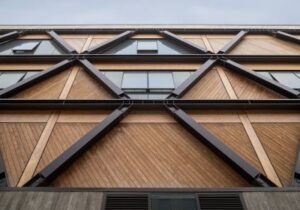
Emerging from this robust base, two mass timber pavilions house classrooms, art studios, and exhibition galleries. Leading onto a green terraced landscape that unites the building’s lower and upper levels, the pavilions are among the first exposed mass timber structures in California. Their deep balconies allow the CCA community to enjoy San Francisco’s mild climate, providing exterior circulation as well as informal learning, working, and social spaces. Their natural materiality and expressive diagrid structure make the lateral and gravity loads of the building visible and speak to the college’s ambitious sustainability goals. Kebony Dually Modified™ Wood, attached with its Click-In Cladding System, was used for the façade.
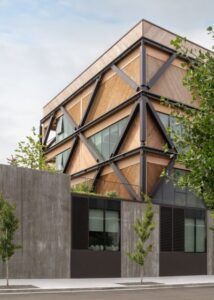
Images Courtesy of: Kristian Alveo
Carved out of the concrete lower level, two large maker yards enable abundant fresh air and natural light to penetrate deep within the interior. Other passive design strategies, such as self-shading façades and night-flush ventilation, naturally cool the building to dramatically reduce the size and energy demand of mechanical systems. With the infrastructure in place to enable a closed-loop, net-positive building in the future, the building’s design is dedicated to supporting healthy, resilient spaces for students, faculty, and visitors.
Through a welcoming new streetscape and programs that seek to increase the impact of art in the wider community, the new building enhances CCA’s connection to San Francisco’s design and innovation district as well as the wider Bay Area and its strong environmental, entrepreneurial, and creative cultures.
Images Courtesy of: Kristian Alveo
About Kebony
Based in Norway, Kebony produces a sustainable and resilient alternative to hardwood and is helping the world reduce its CO2 emissions. Kebony® technology sustainably transforms sustainable softwood species, such as pine, into double-modified wood with characteristics comparable to, and in some cases superior to, those of precious tropical hardwoods. The company’s patent-protected production processes result in products that offer significant improvements in durability and dimensional stability, while maintaining a naturally aesthetic appeal. Primarily used for cladding and decking, Kebony products are chosen for a multitude of exterior applications and design projects in over 100 countries worldwide. Indeed, the need for responsible alternatives in construction is growing, and sustainable wood is becoming the new standard.
View the original article and our Inspiration here
Leave a Reply