
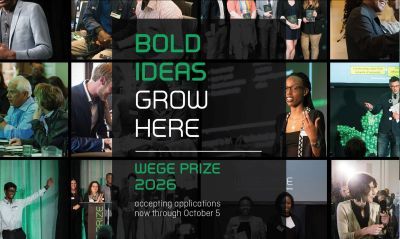
Wege Prize has announced one of its largest rosters of highly diverse student competitors from around the world for the 2026 edition of the sustainability and innovation competition. Hailing from 126 leading institutions of higher education everywhere from South Africa to North America, the competing students become pioneers of real-world approaches
combating “wicked problems” facing the world today, such as hunger, pollution, and waste. Making its acclaimed global competition even better, its 13th edition includes the participation of more expert Judges, bringing knowledge and education to the competing student teams.
With an initial field of 87 student teams, Wege Prize 2026 welcomes 435 participants representing over 30 countries and almost 200 unique academic disciplines. With 52 graduate students and 17 doctoral candidates in addition to 366 undergraduates, the field of competitors brings together a highly international and diverse group of emerging leaders who believe they can make the world a better place.
Image Courtesy of: Wege Prize
Started in 2014, Wege Prize is organized by the Wege Center for Sustainable Design at Ferris State University’s Kendall College of Art and Design (KCAD) to challenge students in higher education to build collaborative teams creating actionable solutions – products, services, or business models – to address ongoing issues affecting people and and the environment. In this way, they take the opportunity inventive ideas into real world solutions to help advance the regenerative, restorative economic framework known as the circular economy.
The teams compete for a cash prize pool of $65,000 USD, more than double the awards granted in previous years. Many of the finalist teams have gone on to win further
honors, gain wide recognition, and launch circular economy enterprises.
This year’s teams include a range of innovative new ventures, including: – Giving new life to lithium-ion batteries by creating a more reliable, faster, and scalable assessment
tool to identify battery cells suitable for second-life applications – not just recycling. – Helping communities anywhere in the world access water source quality, safety and sustainability
information through an interactive, open-source online resource. – Expanding the use of remanufacturing to create more “like new” remade products through an
innovative tracking and data analytics system. – Disrupting the harmful effects of the booming synthetic hair extension industry by replacing petroleum-based plastics with biodegradable plantain fibers.
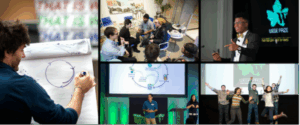
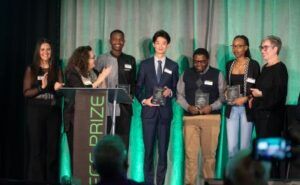
Images Courtesy of: Wege Prize
“On behalf of Wege Prize, KCAD welcomes this very promising field of participants to their first phase of this exciting challenge, where innovative thinking and collaboration become a springboard for new and practical ideas to keep resources in use, regenerate natural systems, and eliminate waste,” says Gayle DeBruyn, a KCAD design professor and Wege Prize principal organizer. “In the face of mounting systemic challenges, these emerging young leaders are working across boundaries to build a better future, standing in stark contrast to a contemporary moment increasingly defined by divisiveness.” How Wege Prize Ignites Innovation Crafted with a proven process with distinct phases over nine months, Wege Prize challenges the student groups to improve their proposed solutions based on in-depth feedback from a multidisciplinary panel of expert judges. As the competition progresses, the judges select finalist teams to present their developed solutions and compete for cash prizes totaling $65,000 USD.
Designed to investigate complex, layered, “wicked problems” and to encourage students in higher education to take a diverse, collaborative approach, Wege Prize leads in promoting the development of new, tangible solutions for the circular economy. The student teams apply their business models or products to be implemented after the competition’s conclusion.
“Wege Prize is unique not just because it focuses on the circular economy, which very few competitions do, but because it asks its entrants to really think all the way around a challenge,” says Nathan Shedroff, a widely published author, educator and Wege Prize judge. “It’s not enough for your solution to just be well engineered, or systemic, or circular – it also has to be feasible, it has to be right for people, and it oftentimes has to help people change their behavior.”

Images Courtesy of: Wege Prize
Based on its success, Wege Prize has been awarded major grant funding in recent years to continue the annual competition. Through promotion and word-of-mouth at leading colleges and universities, WegenPrize has grown significantly in recognition and reach, continually drawing larger fields of participants from multiple continents. By institution location, 33 countries are represented this year, with more students at all levels of higher education.
Many Wege Prize competitors have built their ideas into successful ventures. Among the program’s notable achievers is the 2023 finalist team Banofi Leather, recognized this year by the United Nations Environment Program (UNEP), which has created a thriving enterprise around their formula for making faux leather from banana waste. Another team called Rutopia, recognized by Wege Prize in 2019, garnered the attention of top editors at Forbes, among others, for their eco-sensitive tourism platform that empowers indigenous communities to be players in the ecotourism industry without sacrificing environmental stewardship.
“It’s a real honor being part of Wege Prize,” says the noted educator, entrepreneur and Wege Prize judge Alysia Garmulewicz. “It’s something where I really feel like I learn a lot myself from the students and the work they’re doing. I’m inspired by their passion and the breadth of their thinking.”
About Wege Prize
Wege Prize, a West Michigan-born concept developed by the Wege Center for Sustainable Design at Ferris State University’s Kendall College of Art and Design (KCAD) with the support of The Wege Foundation, is an annual competition that ignites games-changing solutions for the future by inspiring college students around the world to collaborate across institutional, disciplinary, and cultural boundaries and redesign the way economies work. To learn more, go to wegeprize.org.
About KCAD
Located in the heart of downtown Grand Rapids, Michigan, Ferris State University’s Kendall College of Art and Design (KCAD) is committed to creating lasting impact in West Michigan and beyond through collaborative partnerships, cultural innovation, and an educational model that prepares students for leadership in design, the visual arts, and art history; provides innovative, collaborative education that fosters intellectual growth and individual creativity; and promotes the ethical and civic responsibilities of artists and designers, locally and globally.
For more information, please visit kcad.edu.
About The Wege Foundation
Planting seeds that develop leaders in economicology, health, education, and arts, and enhance the lives of people in West Michigan and around the world. For more information, please visit wegefoundation.com.
View the original article and our Inspiration here
Leave a Reply